Middle East Dominance Crumbling? Untold U.S. Losses Revealed
American military dominance in the Middle East is taking a serious beating, according to Ian Carroll's latest video, 'Israel crumbling, Bibi missing, American bases leveled. What they won't tell you on the news.' Carroll argues that mainstream coverage is actively hiding battlefield losses — destroyed radar installations, shuttered shipping lanes, and a region increasingly unwilling to host U.S. forces. Whether you buy his framing or not, the economic math alone is hard to ignore: a closed Strait of Hormuz means 20% of global oil supply going nowhere fast.

Iran's Drone Economy vs. America's Credit Card Military
In Israel crumbling, Bibi missing, American bases leveled. What they won't tell you on the news., Ian Carroll frames the conflict as "a simple cost problem" — Iran mass-produces drones and missiles at a fraction of what the U.S. spends intercepting them.
When a $2,000 drone takes down a THAAD battery worth several billion dollars, the exchange rate starts looking ugly. Carroll says that math is playing out across the region right now.
Bases Across the Gulf Are Apparently Not Fine
Satellite imagery Carroll cites points to damaged or destroyed military infrastructure across Qatar, Jordan, Kuwait, Bahrain, Saudi Arabia, the UAE, and Iraq — basically the entire U.S. footprint in the Middle East.
The radar and missile defense systems meant to protect those bases are, per Carroll's sourcing, either gone or compromised, which makes the next wave of attacks considerably easier to land.
The Strait of Hormuz and a Shipping Crisis Nobody Wants to Say Out Loud
Carroll says commercial shipping through the Strait of Hormuz has effectively stopped — not because of a blockade, but because marine insurers have quietly walked away from the risk.
No insurance means no ships. No ships means the 20% of global oil that moves through that narrow strip of water isn't moving, and neither are the fertilizer shipments that a large chunk of the world's food supply depends on.
Netanyahu, China, and the Rest of the Chaos
Carroll floats unverified claims about Netanyahu's recent absence from public view, pointing to what he describes as a suspiciously AI-generated video as possible evidence of something being hidden — injury, or worse. Unconfirmed, but he finds the timing odd.
On the bigger geopolitical board, Carroll argues China is the quiet winner here, using the conflict to study U.S. military tactics and, potentially, to feed targeting intelligence to Iran — treating the whole thing as a live-fire intelligence exercise ahead of whatever comes next.
Our Analysis: Carroll gets the insurance angle right — when Lloyds won't cover your tanker, the Strait is functionally closed whether Iran fires another shot or not. The drone-cost asymmetry point is also solid; America is burning $2M missiles to swat $20K UAVs, and that math compounds fast.
Where he overreaches: the "bases leveled" framing leans on unverified claims, and the censorship narrative conveniently fills every gap in his argument.
The broader trend is real though — proxy conflicts are now intelligence goldmines for China, and every U.S. system exposed here gets studied. Expect that to shape Pacific strategy more than anything happening in Tehran.
What Carroll doesn't fully unpack is how the insurance market dynamic represents a structural shift, not a temporary blip. War risk premiums don't come back down quickly once underwriters decide a corridor is radioactive. The Red Sea rerouting after Houthi attacks added weeks and millions to shipping costs — and carriers adjusted their entire routing infrastructure as a result. A similar recalibration around the Strait of Hormuz would be an order of magnitude more disruptive, given the volume. This isn't a crisis that resolves when the shooting stops; it resolves when actuaries say it does.
There's also an underreported dimension to the food supply angle. Carroll mentions fertilizer shipments in passing, but the knock-on effects deserve more attention. Disrupted fertilizer flows translate to reduced yields in import-dependent agricultural economies — places that are already running thin on food security buffers. The geopolitical instability that follows a bad harvest season in a fragile state can dwarf the original military conflict in human cost. That feedback loop rarely makes the news until it's already a crisis.
Finally, the China-as-observer framing is worth taking seriously even if Carroll's sourcing stays thin. The U.S. burned through an enormous amount of air defense inventory in this conflict. Replenishment timelines for systems like THAAD and Patriot run into years, not months. Any adversary watching that depletion rate — and doing the arithmetic on production capacity — is gaining something more valuable than battlefield intelligence. They're gaining a window.
Source: Based on a video by Ian Carroll — Watch original video
This article was generated by NoTime2Watch's AI pipeline. All content includes substantial original analysis.
Related Articles

Afroman Trial: Free Speech Wins vs Police Defamation
A jury ruled in favor of rapper Afroman in a defamation lawsuit brought by the police officers who raided his home in 2022, finding that his satirical songs about the raid were protected under the U.S. First Amendment. Officers had sued after Afroman turned surveillance footage of their conduct — including one officer's apparent fascination with a lemon pound cake — into viral music mocking them by name. Josh Johnson's video 'The Afroman Trial Explained: Cops vs Hip Hop' breaks down how the case went from an unwarranted drug raid to a courtroom win that doubled as a free speech lesson.

Josh Johnson on Cassette Tapes: The Physics Problem
Comedian Josh Johnson stumbled onto a physics problem he didn't expect: he couldn't explain how a cassette tape actually works. In his video "Please help me explain this to younger people," Johnson tries to walk a younger person through magnetic tape technology and realizes mid-explanation that he's lost on the actual physics. The moment lands as comedy, but it points to something real — most people who grew up with cassette tapes and CDs used them daily without ever understanding how a strip of coated plastic, or a pressed disc, became music.
US-Iran War: What Washington Isn't Telling You
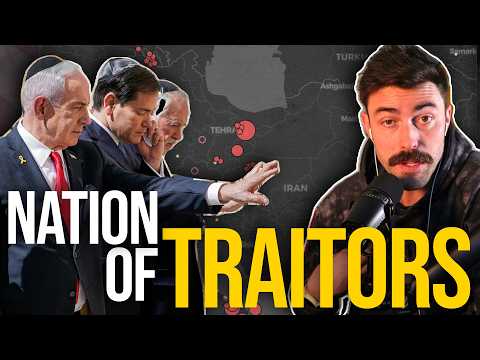
The US-Iran war is going worse than Washington is letting on, according to Ian Carroll's latest video, 'War in Iran is not going as well as they're telling you.' Carroll, drawing on open-source satellite imagery and independent analysts, argues that Iran has successfully destroyed multi-billion-dollar US and Israeli radar systems, closed the Strait of Hormuz without firing a shot, and turned an early airstrike on a girls' school into a recruitment poster. He's openly anti-Israel and says so upfront — which is either a red flag or a refreshing change, depending on who you ask.