Claude Code Memory 2.0: Anthropic's AutoDream Explained
Anthropic has shipped an experimental feature for Claude Code called AutoDream, a background memory consolidation system that periodically organizes and prunes Claude's context files to keep interactions sharp over time. @nateherk breaks it down in 'Claude Code Just Dropped Memory 2.0' — and it's genuinely one of the more interesting things to land in AI tooling recently. The short version: Claude now basically sleeps on your project, trims the fat from its memory files, and wakes up less confused about who you are and what you're building.
What AutoDream Actually Does
AutoDream runs a background sub-agent that reviews past sessions, identifies what's worth keeping, and rewrites Claude's memory files — MD files only, no touching your code — into something cleaner and more useful.
Anthropic's own framing is that it mimics how human brains consolidate memories during sleep, which sounds like marketing until you realize the process genuinely involves merging redundant entries, pruning stale context, and refreshing what remains.
How It Differs from AutoMemory
Claude Code already had an automemory feature, which stores project-specific details and injects them into future sessions.
AutoDream sits on top of that — it's less about storing information and more about stopping those files from turning into a bloated mess over time. In Claude Code Just Dropped Memory 2.0, @nateherk breaks down how the practical result is less repetition in conversations and a Claude that actually remembers the relevant stuff without you re-explaining your whole stack every few weeks.
Three Steps, One Sub-Agent
The process runs in three stages: gather session data, read the existing memory files, then fire a sub-agent with a specific consolidation prompt to run the actual dream cycle.
Depending on your interaction history, it can take a few minutes — but @nateherk shows it holding up reasonably well even under a heavy session load.
Turning It On
You enable it via the '/memory' command inside Claude Code, and you can trigger a dream cycle manually with '/dream' or just ask for it in plain language.
Automatic triggers — think time intervals or session thresholds — are currently being debated in the community but aren't officially confirmed yet. It's experimental, the toggle is simple, and that's about where the certainty ends for now.
Our Analysis: The sleep-consolidation metaphor isn't just cute — it's a genuinely smart design choice, because bloated context is one of the real friction points killing long-running AI workflows right now.
This fits the broader push toward AI agents that manage their own cognitive overhead, not just execute tasks — we're slowly offloading the mental housekeeping entirely.
The interesting question is what gets lost in pruning. Human brains forget things for good reasons, but also bad ones — if AutoDream starts quietly dropping context users actually needed, that's a trust problem waiting to happen.
There's also a deeper question about auditability. When a human forgets something, that's a known limitation of the medium. When a tool forgets something by design, users reasonably expect to understand what was dropped and why. Right now, AutoDream appears to operate as a largely opaque background process — which is fine for an experimental feature, but will need to evolve as adoption grows. A consolidation log, even a simple one, would go a long way toward keeping users in the loop.
It's also worth noting what AutoDream signals about where Claude Code is headed as a product. Memory management has historically been the user's problem — you cleaned up your context files, you decided what to carry forward, you paid the cognitive tax. Automating that layer suggests Anthropic is serious about Claude Code functioning less like a stateless tool and more like a persistent collaborator. That's a meaningful shift in product philosophy, not just a feature drop.
The risk, of course, is over-reliance. If users stop actively curating their context because AutoDream handles it, and AutoDream makes a bad call, the failure mode is subtle — Claude quietly working from a slightly wrong model of your project, with no obvious signal that something drifted. That's harder to debug than a missing file. Worth watching as the feature matures out of experimental status.
Source: Based on a video by @nateherk — Watch original video
This article was generated by NoTime2Watch's AI pipeline. All content includes substantial original analysis.
Related Articles
Paperclip AI Tool: Turn Claude Code Into an Agent Company
A new open-source tool called Paperclip lets you run an entire AI-driven company from a single dashboard, with minimal human input required. Nate Herk of Nate Herk | AI Automation broke it down in his video 'This One Tool Turns Claude Code Into an Entire Agent Company,' showing how the platform orchestrates intelligent agents in AI roles — CEO, marketer, engineer — while the user just sets goals and watches the thing run. It's free, it's on GitHub, and it's gaining traction fast among people who'd rather manage a board meeting than a Slack channel.
Cloud Code Auto Mode: Stop Bypass Permissions
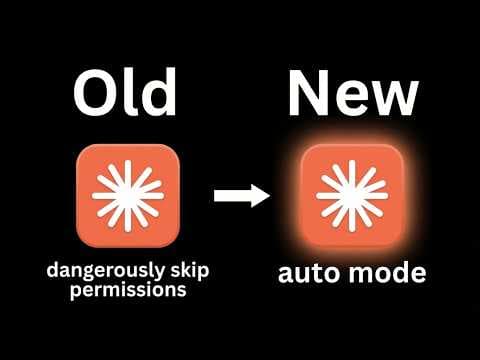
Claude's Cloud Code has a new 'auto mode' that handles permissions on its own, and @nateherk's video 'STOP Using Bypass Permissions, Use This New Feature Instead' breaks down why it matters. Until now, developers were stuck choosing between constant approval prompts that killed their workflow or a full permission bypass that let the AI do basically anything unchecked — neither great. Auto mode sits in the middle, classifying each action for risk before running it, so safe stuff executes quietly and sketchy stuff gets flagged. It's in research preview and currently limited to Team plan subscribers.

Gemini 3.1 Flash Live: The Future of Voice Agents
Google's Gemini 3.1 Flash Live ditches the old speech-to-text-to-speech pipeline in favor of direct audio processing, and according to @nateherk's breakdown in 'Gemini 3.1 Flash Live Just Changed Voice Agents Forever,' the difference is noticeable. The model posts a 19% improvement in multi-step function calling over its predecessor, handles noisy real-world environments well, and is already free to test in Google AI Studio. There are rough edges — it goes silent mid-conversation while executing functions — but the overall package is a genuine step forward for anyone building voice agents.